Bullard is growing faster than any other town on this site with a 2025 Census estimate. The Census Bureau puts it at 5,301 people in July 2025, about 39% above its April 2020 base of 3,808. That base is higher than the 3,318 people counted in the 2020 Census because it uses today’s town limits. Bullard is about 16 miles from downtown Tyler by road. Most of its houses went up in 2000 or later, so this page starts with newer foundations.
Can a newer Bullard house have foundation trouble?
It is a common question from owners of new houses in Texas. One owner of a house about a year old, with large drywall cracks, asked in a Texas forum: “Is this normal, or a bit excessive?” With 73.7% of Bullard’s 1,664 homes built in 2000 or later, the question fits here. Measurements answer it better than guesses.
The Census detail: 623 homes were built from 2000 to 2009, 487 in the 2010s and 117 from 2020 on, against only 189 before 1980. The median year built is 2006. Owners live in 86.1% of occupied homes, and the median owner-occupied value is $247,100.
Engineers judge movement with two numbers. The Foundation Performance Association recommends tilt of 1% or less and deflection of no more than L/360, and the ASCE Texas Section’s repair guidelines note that “A tilt greater than 1 percent is usually noticeable.” These are professional guidelines, not law, but they give you a yardstick for any report.
If the house is still under a builder’s warranty, read what it covers and how to make a claim before you pay anyone for repairs. An independent engineer’s report, usually $300 to $800, is yours to keep whichever way it goes. Our guide to the signs of foundation problems covers what to watch and log.
Which county is your Bullard house in, and does it matter?
It can. Bullard sits in both Smith and Cherokee counties, and each county has its own soil survey. Smith County’s was issued in 1993. Cherokee County’s latest is a manuscript from 1959, so soil records for the Cherokee side are older and less exact. Either way, a survey describes broad areas, not single lots.
On the Smith County side, roughly four-fifths of the county is Ultisols and Alfisols, soils with a sandy or loamy surface over a clay-enriched subsoil. The survey still flags some of them for shrink-swell on building sites, among them the Bowie and Cuthbert soils.
On the Cherokee side, the 1959 survey mapped four soil associations: Bowie-Lakeland-Eustis on about 41% of the county, Nacogdoches-Magnolia-Bub on 25%, Boswell-Susquehanna on 18% and Tuka-Bibb on 16%. Boswell and Susquehanna are now classed as vertic soils, and the current Susquehanna description is smectitic. Treat the Cherokee picture as provisional.
What does the Town of Bullard require before work starts?
A call to the town comes first. Bullard adopted the 2021 International Residential Code on July 8, 2025, by Ordinance 2025-0708-2, and its building official is the City Manager or a designee. Permit fees are set in section 2-338 of the town code, but we could not retrieve the amounts. Call (903) 894-7223.
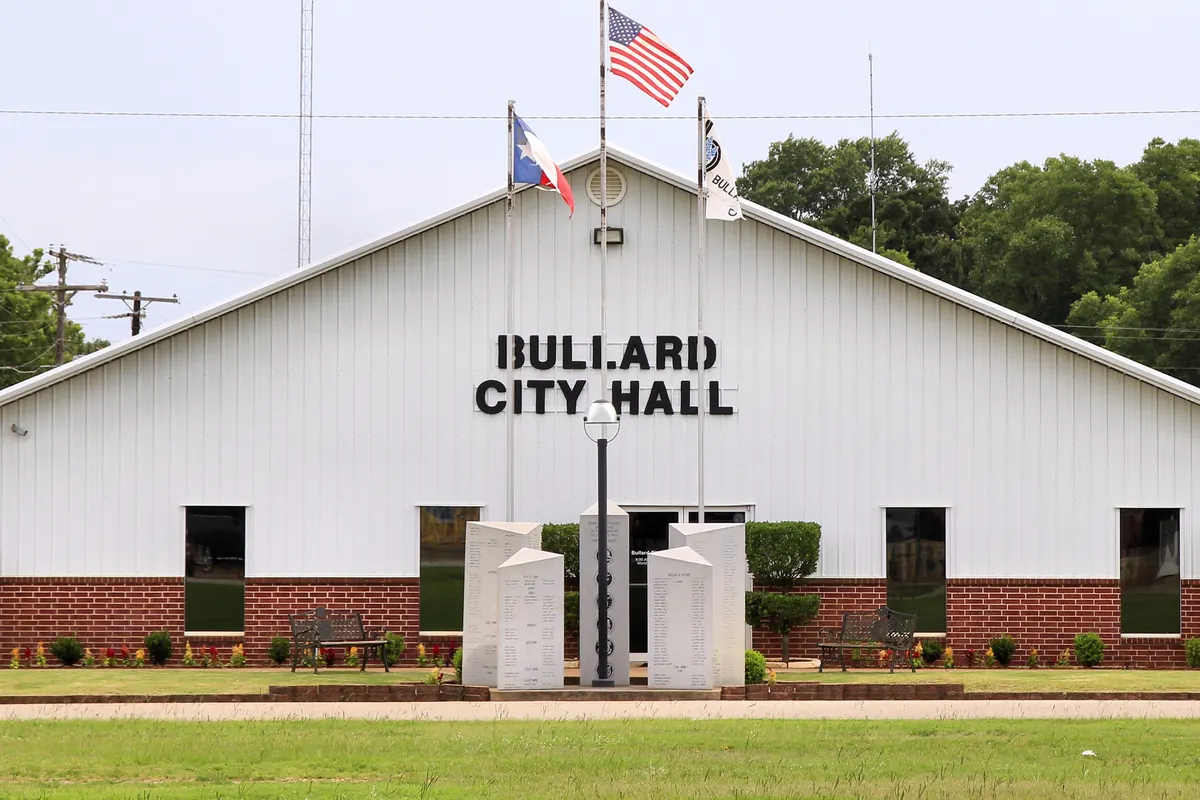
The town adopted the 2021 International Building Code on the same date. We found no local change to the permit section of the residential code, which suggests the model code’s rules on permits stand. The town website’s menu lists Permits, Permit Applications & Forms, Development Services and Code Compliance, and City Hall is at 114 S. Phillips.
Is Emerald Bay covered by Bullard’s rules?
No. Emerald Bay is a Census-designated place in Smith County, not part of any city, so the Town of Bullard’s permit rules do not reach it. Outside cities, Smith County’s only local building rules are its subdivision regulations. A home in a mapped flood zone still needs the county’s floodplain development permit.
Emerald Bay’s housing is quite different from the town’s. Its 512 housing units have a median year built of 1987, with 33.6% from before 1980 and 26.4% from 2000 or later. All 489 occupied homes are owner-occupied, the median value is $351,000, and water covers about half of its mapped area. Our Flint and Gresham page covers the county rules in full.
Has Bullard’s housing been through a drought?
The older part of it has. Bullard’s 623 homes built from 2000 to 2009 stood through 2011, when Tyler Pounds Field got 25.00 inches of rain, 59% of normal, and the U.S. Drought Monitor showed exceptional drought over all of Smith County on 11 weekly maps in a row. Newer homes met a shorter drought in 2022.
The 2011 record at the station also shows 140 days of 90°F or more and a high of 110°F. In 2022 the station logged 33.73 inches, about 80% of normal, and extreme drought covered about two-thirds of the county for two weeks in mid-August before it broke. It was a sharp summer drought, not a repeat of 2011.
The ASCE Texas Section’s guidelines point to two things an owner can control: “Trees or large shrubs near a foundation may cause soil shrinkage under the foundation,” and “Downspouts should be extended well past the edge of the foundation, past the edge of abutting planting beds, and into well-drained areas.” See drainage correction.
Before you hire anyone
Check the company yourself
Texas does not license foundation repair companies. Bills to create a license passed the Senate in 2011 and died in the House, and a second attempt in 2013 also failed (SB 1399, HB 613). So the checks that matter are yours to make. Each takes a few minutes.
- Ask who the engineer is. The Texas engineering board says working out why a foundation moved, or recommending how to repair it, is the practice of engineering (Advisory Opinion 43). Get the engineer's name and look up the license on the state roster.
- Check the plumber's license. If the job includes a plumbing test or a leak repair, the plumbing has to be done under a licensed plumber. Look the license up with the Texas State Board of Plumbing Examiners.
- Read the warranty before you sign. Get it in writing, see whether it transfers when you sell, and find the clauses that void it. Watering and plumbing conditions are the ones homeowners most often learn about too late.
- Ask who pulls the permit. Most cities here charge a permit fee for repairs, and Canton names foundation repair in its fee schedule. Unincorporated county land has no building permit at all. Our permit guide lists each office.
- Keep the paperwork. If a job goes wrong, Texas law makes you give the company written notice at least 60 days before you sue under the Deceptive Trade Practices Act (Bus. & Com. Code §17.505). Estimates, contracts, photos and emails are your record.
What happens after you call or send the form
- 1
Your request goes to one company
We pass it to one independent foundation repair company that works in your area. Not a list, and not an auction.
- 2
They call to set up a visit
Most Tyler-area foundation companies advertise a free inspection or estimate. Ask on that first call, so there are no surprises.
- 3
You get a written estimate
It should name the repair method, how many piers and where, who designs the repair, the permit, the warranty and the price. Compare it with our published price ranges.
- 4
You decide
There is no obligation. If you want a second opinion, an independent structural engineer's evaluation usually costs $300 to $800.
Where to read next for a newer Bullard home
Pick the page that matches the problem. For cracks or sticking doors in a slab house, start with an inspection, then slab repair if the numbers call for it. For water standing by the house, drainage. For a builder or warranty dispute, the warranty guide. Our cost guide gives a sourced range for each.
- Foundation inspection: the engineer’s evaluation and what it should include.
- Slab foundation repair: piers, lifting and plumbing tests.
- Foundation crack repair: sealing cracks, and why that alone does not stop movement.
- Foundation repair warranties: what to read before you sign or sell.
Bullard’s neighbors: Whitehouse and Flint
Whitehouse is a Smith County city with a permit office at City Hall; its median home dates from 1995, against Bullard’s 2006. Flint and Gresham are unincorporated, so no city permit applies there. For the Cherokee County offices, see our Jacksonville page.
Bullard foundation questions
New house, foundation settling or something worse?
Only measurements can say. A structural engineer can survey the floors and compare tilt and deflection with published guidelines: the Foundation Performance Association recommends tilt of 1% or less and deflection of no more than L/360. If a builder’s warranty is still in force, read its claim steps before you pay anyone. An independent evaluation usually costs $300 to $800.
Do I need a permit for foundation repair in Bullard?
Ask the town before work starts. Bullard adopted the 2021 International Residential Code in July 2025, and the City Manager or a designee is the building official. We found no local change to the code’s permit section, and we could not retrieve the fee amounts in section 2-338. Call (903) 894-7223, or have the company confirm the permit in writing.
Which soil survey covers my Bullard lot?
It depends on the county line. On the Smith County side, the 1993 Soil Survey of Smith County applies. On the Cherokee County side, the latest published survey dates from 1959, and some of its soil names have since been reclassified. Neither survey maps single lots, so only an engineer’s evaluation can tell you what the ground is doing under your house.
What does foundation repair cost in Bullard?
No Tyler-area company we checked publishes prices, and no public dataset exists. Industry estimates put a slab repair with piers at $5,000 to $25,000, and crack injection, which seals a crack but does not stop movement, at $250 to $800 per crack. Add any town permit fee. Our cost guide lists the sources.
Sources
Each source was opened and checked on the date shown. If a link has moved, tell us and we will fix it.
- 2020 Census, Demographic and Housing Characteristics, table P1 (places in Smith County), U.S. Census Bureau. Checked September 21, 2026.
- QuickFacts: Bullard town, Texas (Vintage 2025 estimate and estimates base), U.S. Census Bureau. Checked September 21, 2026.
- Year Structure Built (B25034), ACS 2020-2024 5-year, places in Smith County, U.S. Census Bureau. Checked September 21, 2026.
- Median Year Structure Built (B25035), ACS 2020-2024 5-year, places in Smith County, U.S. Census Bureau. Checked September 21, 2026.
- Tenure (B25003), ACS 2020-2024 5-year, places in Smith County, U.S. Census Bureau. Checked September 21, 2026.
- Median Value of Owner-Occupied Housing Units (B25077), ACS 2020-2024 5-year, places in Smith County, U.S. Census Bureau. Checked September 21, 2026.
- Geographic information (land and water area), places in Smith County, U.S. Census Bureau. Checked September 21, 2026.
- Town of Bullard home page (address, phone, Permits menu), Town of Bullard. Checked September 21, 2026.
- Bullard Code of Ordinances, Chapter 8, Article VIII (2021 International Residential Code), Town of Bullard (Municode API). Checked September 21, 2026.
- County Ordinances and Policies (10.01 Building and Construction Permit Policy), Smith County. Checked September 21, 2026.
- Soil Survey of Smith County, Texas (Hatherly, 1993), USDA Soil Conservation Service, via Internet Archive. Checked September 21, 2026.
- Soil Survey, Cherokee County, Texas (Mowery and Oakes, 1959), USDA Soil Conservation Service, via Internet Archive. Checked September 21, 2026.
- Official Series Description: Susquehanna, USDA Natural Resources Conservation Service. Checked September 21, 2026.
- Global Summary of the Year, Tyler Pounds Field, 2010 to 2023, NOAA National Centers for Environmental Information. Checked September 21, 2026.
- Drought severity statistics, Smith County, July to December 2011, U.S. Drought Monitor. Checked September 21, 2026.
- Drought severity statistics, Smith County, May to December 2022, U.S. Drought Monitor. Checked September 21, 2026.
- FPA-SC-13-1, Guidelines for the Evaluation of Foundation Movement for Residential and Other Low-Rise Buildings, Foundation Performance Association. Checked September 21, 2026.
- Guidelines for the Evaluation and Repair of Residential Foundations, Version 3, ASCE Texas Section. Checked September 21, 2026.
- Driving distances to downtown Tyler (OSRM routing engine, OpenStreetMap roads), Project OSRM. Checked September 21, 2026.
- New house, foundation settling or something worse? (forum thread), TexAgs. Checked September 21, 2026.