Flint and Gresham are Smith County communities, not cities. Neither is a city or a Census-designated place. So no city issues building permits there, and the Census publishes no figures for either one. That changes who checks a foundation repair, and the answer is mostly you.
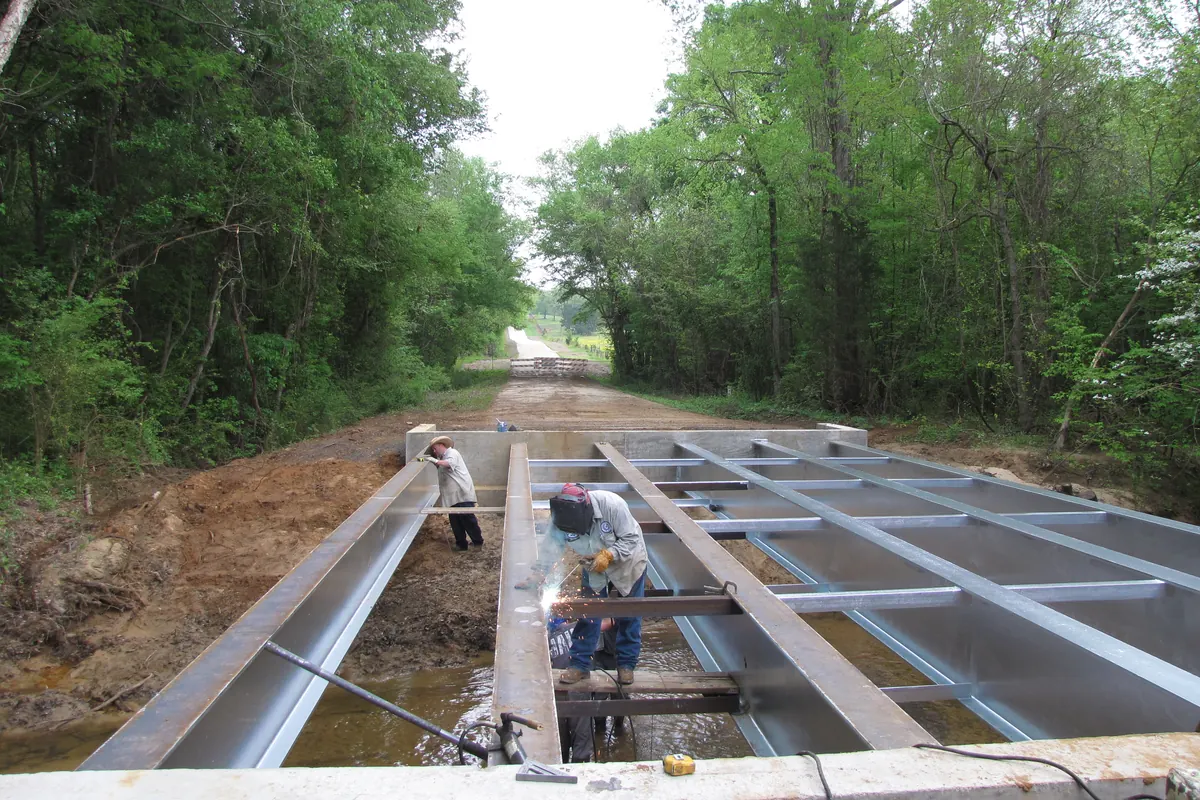
Is your Flint or Gresham address inside Tyler’s city limits?
Check before you assume. Census map checks put the Flint and Gresham map points outside every city. But a community covers more ground than a point, and parts of the Flint mailing area could lie inside Tyler. Tyler’s own FAQ sends residents to SmithCountyMapSite.org to look up an address.
If the house is inside the city, Tyler’s permit rules and fees apply; our Tyler page covers them. Census boundaries can also trail behind recent annexations, so a lookup on the county map beats a guess from a mailing address.
We found no source saying Tyler requires building permits in the area just outside its limits, called the extraterritorial jurisdiction. If a company tells you otherwise, ask it to show you the rule.
What does Smith County regulate outside the cities?
Very little that touches a foundation job. The county says it has no local building policies for construction outside cities apart from subdivision rules. So there is no county building permit and no county building inspection. It does require a development permit in mapped flood zones, and it runs a septic permit program through a contractor.
The county Fire Marshal’s page lists inspections of businesses such as daycares, schools and nursing homes, and says nothing about homes. Septic permits go through the county’s contractor, RTS Environmental, at (903) 630-4234.
State law lets a county opt in to a building code for new homes outside cities (Local Government Code Chapter 233, Subchapter F). It covers only new houses on vacant lots and additions that grow a house by more than 50%. It never covers repairs, and we found no Smith County order adopting it.
When does a flood zone change the job?
When the house sits in a mapped flood hazard area. Smith County’s 2008 flood rules require a development permit there, and they define “development” to include “excavation, or drilling operations.” Work costing 50% or more of the building’s market value is a “substantial improvement.” Call the floodplain administrator at Road & Bridge, (903) 590-4801.
The county’s permit form covers Zones A and B on FEMA’s flood maps, and its categories include “substantial improvement to an existing structure.” The office is at 135 SSE Loop 323 in Tyler, open weekdays 7:30 a.m. to 4 p.m., and the mailing address is P.O. Box 990, Tyler, TX 75710.
Whether a pier job counts as “drilling operations” is not spelled out, so ask before the company digs.
What takes the place of a city inspection?
Your paperwork. With no permit and no inspector, the written contract, the engineer’s design and the engineer’s letter after the work are the only independent record of what was done. Texas law also requires the contractor to hand you a disclosure statement before you sign a residential construction contract.
That statement, under Property Code section 53.255, opens with “KNOW YOUR RIGHTS AND RESPONSIBILITIES UNDER THE LAW.” If you want to know whether a company follows the law, notice whether it arrives before the contract does.
Section 53.254 adds a rule for homesteads. For a contractor to put a lien on your homestead, you and the contractor must sign a written contract before work starts. If you are married, both spouses must sign. Read the contract for any lien language.
Ask who the engineer is, and get a letter after the repair ($200 to $500, based on one published source). Photograph the house before and after, with the date showing. Our hiring checklist goes through the rest.
How old are homes in the 75762 ZIP area?
Mostly built from 1980 on. The Census has no figures for Flint or Gresham themselves, so the closest stand-in is ZIP code area 75762, which covers more ground than either community. Of its 5,884 housing units, 50.0% were built in 2000 or later and 17.3% before 1980. The median year built is 2000.
For a house built outside city limits, there may be no city inspection record at all. If you are buying one, ask the seller for any engineer’s foundation design, soil report or inspection. Then hire your own engineer before closing; see buying a house with foundation repair.
Rural lots bring drainage questions too. The ASCE Texas Section’s repair guidelines say “a minimum slope of 5 percent (i.e. 6 inches in 10 feet) away from the foundation should be provided for the first 10 feet all around.”
Before you hire anyone
Check the company yourself
Texas does not license foundation repair companies. Bills to create a license passed the Senate in 2011 and died in the House, and a second attempt in 2013 also failed (SB 1399, HB 613). So the checks that matter are yours to make. Each takes a few minutes.
- Ask who the engineer is. The Texas engineering board says working out why a foundation moved, or recommending how to repair it, is the practice of engineering (Advisory Opinion 43). Get the engineer's name and look up the license on the state roster.
- Check the plumber's license. If the job includes a plumbing test or a leak repair, the plumbing has to be done under a licensed plumber. Look the license up with the Texas State Board of Plumbing Examiners.
- Read the warranty before you sign. Get it in writing, see whether it transfers when you sell, and find the clauses that void it. Watering and plumbing conditions are the ones homeowners most often learn about too late.
- Ask who pulls the permit. Most cities here charge a permit fee for repairs, and Canton names foundation repair in its fee schedule. Unincorporated county land has no building permit at all. Our permit guide lists each office.
- Keep the paperwork. If a job goes wrong, Texas law makes you give the company written notice at least 60 days before you sue under the Deceptive Trade Practices Act (Bus. & Com. Code §17.505). Estimates, contracts, photos and emails are your record.
What happens after you call or send the form
- 1
Your request goes to one company
We pass it to one independent foundation repair company that works in your area. Not a list, and not an auction.
- 2
They call to set up a visit
Most Tyler-area foundation companies advertise a free inspection or estimate. Ask on that first call, so there are no surprises.
- 3
You get a written estimate
It should name the repair method, how many piers and where, who designs the repair, the permit, the warranty and the price. Compare it with our published price ranges.
- 4
You decide
There is no obligation. If you want a second opinion, an independent structural engineer's evaluation usually costs $300 to $800.
Repairs to read about before you hire
With no inspector checking the job, know the method before you sign. These pages explain each kind of work, the steps a careful company follows, and what to ask. The cost guide gives industry ranges with sources. None of the Tyler-area company sites we checked lists prices.
- Foundation inspection: the engineer’s evaluation that should come first.
- Slab foundation repair: pier methods and the report you should get after.
- House leveling: shims, new piers and sill work under a pier-and-beam house.
- Drainage correction: grading and gutters on a sloped rural lot.
Neighbors: Bullard and Tyler
Bullard has a town building official and adopted the 2021 residential code in July 2025, so a permit call comes first there. Tyler, about 12 miles from Flint by road, prices repair permits by the square foot. Inside either one, city rules replace the county rules on this page.
Flint and Gresham foundation questions
Do I need a permit for foundation repair in Flint or Gresham?
Not from the county, unless the house is in a mapped flood zone. Smith County says it has no local building policies for construction outside cities other than subdivision rules. In a flood hazard area, the county’s 2008 flood rules require a development permit. First make sure the address is not inside Tyler’s city limits, where Tyler’s rules would apply.
Who inspects foundation work if the county doesn't?
No city or county office inspects a home foundation repair here. The check has to come from people you choose: a Texas licensed professional engineer who designs the repair and writes a letter after it, and a licensed plumber for any plumbing test or leak repair. Keep the engineer’s report, the contract, the letter and dated photos together.
How do I know if my house is in a flood zone?
Ask the county’s floodplain administrator at Smith County Road & Bridge, (903) 590-4801, 135 SSE Loop 323 in Tyler, weekdays 7:30 a.m. to 4 p.m. The county’s permit form covers Zones A and B on FEMA’s flood maps. Ask before any work that digs, drills or fills around the house.
What does foundation repair cost outside Tyler's city limits?
Outside city limits there is no city permit fee to add. No Tyler-area company we checked publishes prices, and no public dataset exists. Industry estimates put a slab repair with piers at $5,000 to $25,000, a pier-and-beam re-level at $1,200 to $4,000, and an engineer’s post-repair letter at $200 to $500 (one published source). See the cost guide.
Sources
Each source was opened and checked on the date shown. If a link has moved, tell us and we will fix it.
- Year Structure Built (B25034), ACS 2020-2024 5-year, ZIP code area 75762, U.S. Census Bureau. Checked September 21, 2026.
- Median Year Structure Built (B25035), ACS 2020-2024 5-year, ZIP code area 75762, U.S. Census Bureau. Checked September 21, 2026.
- TIGERweb Places layers (incorporated places and Census-designated places), U.S. Census Bureau. Checked September 21, 2026.
- Development and Planning FAQs (city limits check), City of Tyler. Checked September 21, 2026.
- SmithCountyMapSite.org (property and city limits lookup), Smith County. Checked September 21, 2026.
- County Ordinances and Policies (10.01 Building and Construction Permit Policy), Smith County. Checked September 21, 2026.
- Flood Damage Prevention Regulations (adopted September 8, 2008), Smith County. Checked September 21, 2026.
- Floodplain Development Permit form, Smith County. Checked September 21, 2026.
- Road & Bridge, Smith County. Checked September 21, 2026.
- Fire Marshal, Smith County. Checked September 21, 2026.
- On-Site Sewage Facility (septic) program, Smith County. Checked September 21, 2026.
- Local Government Code Chapter 233, Subchapter F (residential building code standards in unincorporated areas), State of Texas. Checked September 21, 2026.
- Property Code Chapter 53 (sections 53.254 and 53.255), State of Texas. Checked September 21, 2026.
- Guidelines for the Evaluation and Repair of Residential Foundations, Version 3, ASCE Texas Section. Checked September 21, 2026.
- Engineering Advisory Opinion 43 (foundation evaluations), Texas Board of Professional Engineers and Land Surveyors. Checked September 21, 2026.