Call the one whose job matches your question. A home inspector reports what is visible, a foundation repair company inspects and prices its own repair, and only a licensed engineer is meant to diagnose the cause and design the fix. Texas rules draw those lines, and they decide who you should call first. This is general information, not legal or engineering advice.
Who does what: inspector, engineer or foundation company?
Each has a different job under Texas rules. A home inspector licensed by the Texas Real Estate Commission reports visible signs and gives an opinion on how the foundation is performing. A licensed Professional Engineer diagnoses the cause and designs the repair. A foundation repair company, which needs no state license, inspects and prices its own repair.
| Home inspector | Structural engineer | Foundation repair company | |
|---|---|---|---|
| State license | Yes, from the Texas Real Estate Commission | Yes, Professional Engineer (P.E.) | None exists |
| Main job on a foundation | A visual inspection and a written opinion on performance | Finds the cause, measures the house, designs the repair | Inspects, proposes and prices a repair |
| Typical cost | Part of a home inspection | $300 to $800 for an evaluation and report (industry estimate) | Usually free |
What does a home inspector check?
The visible signs. Texas inspection rules make the inspector “render a written opinion as to the performance of the foundation” and report visible indications of “adverse performance”. They do not require the inspector to find the cause or to recommend engineering, and the engineering board says an inspection done to those rules is not engineering.
The Standards of Practice (22 TAC §535.228) list the signs an inspector should generally report:
- “binding, out-of-square, non-latching doors”
- “framing or frieze board separations”
- “sloping floors”
- “window, wall, floor, or ceiling cracks or separations”
- “rotating, buckling, cracking, or deflecting masonry cladding”
The inspector must also report the type of foundation and “the vantage point from which the crawl space was inspected.” But the rules also say an inspector is not required to “enter a crawl space or any area where headroom is less than 18 inches or the access opening is less than 24 inches wide and 18 inches high,” or to “provide an exhaustive list of indicators of possible adverse performance.” Nor must an inspector determine “the cause or source of a condition” or “recommend or provide engineering, architectural, appraisal, mitigation, physical surveying, realty, or other specialist services” (§535.227).
The engineering board agrees with that split: “We conclude that a TREC licensed inspector who conducts a visual real estate inspection in conformance with the TREC Standards of Practice does not engage in the practice of engineering.” TREC’s inspector committee has been drafting changes to these standards in 2026; the update we read did not mention foundations. You can check an inspector’s license with TREC’s license holder search. If you are buying, read buying a house with foundation repair.
What does a structural engineer do that the others don’t?
Finds the cause and designs the fix. The Texas engineering board says that analyzing the cause of a foundation problem, or recommending a repair, is the practice of engineering. The ASCE Texas Section guidelines say “The evaluation and repair design shall be performed by a professional engineer licensed in the State of Texas.”
The ASCE document is a professional guideline, not law. The law has its own rule for this area. Engineering design to repair “a residential dwelling slab located on expansive soil that meets the expansive soil classification provisions of the International Residential Code as applied in the jurisdiction in which the residential dwelling is located” falls outside the usual private-dwelling exemption unless the work meets that code (Occupations Code §1001.056(c)(2)). The House Research Organization’s 2009 analysis of the bill that added it said it “would ensure that persons performing certain activities relating to windstorm standards and those working with residential slab foundations in expansive soils are licensed and regulated by the engineering board.”
Two cities here tie foundation work to an engineer. Canton’s fee schedule reads “Foundation Repairs $50.00 with Engineer Design”. Athens requires every foundation “regulated by this code” to be “designed and sealed by a Texas-registered engineer”, though it does not say whether repairs count. The permit guide has the details.
How an engineer measures a foundation
Engineers look at two numbers. Tilt is “a post-construction planar rotation, measured over the entire length, width, or diagonal of the Foundation.” Deflection is “the post-construction vertical displacement of a structural element due to bending”, in plain terms a sag or a hump between two points.
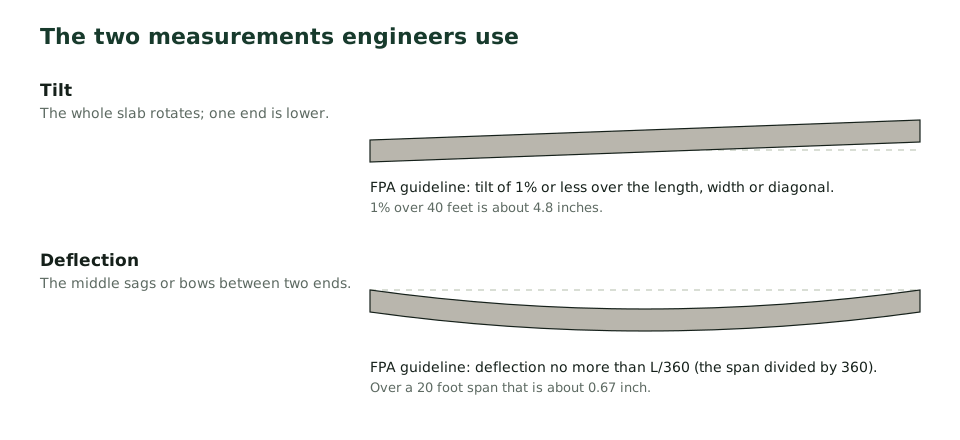
The Foundation Performance Association, a Houston professional group, recommends “that Tilt be less than or equal to one percent (1%) over the entire length, width, or diagonal of the Foundation” and “that Deflection not exceed the Effective Length, L, divided by 360 (or 0.0028L)”. It recommends a minimum effective length of “20 feet or the width of the Foundation, whichever is less.” In inches, L/360 is about 0.67 inch over 20 feet and 1.0 inch over 30 feet, and a 1% tilt is 4.8 inches over 40 feet.
The ASCE guidelines add context: “A tilt greater than 1 percent is usually noticeable. The Americans with Disabilities Act considers a 2 percent slope too large.” The FPA asks for survey equipment precise to 1/8 inch, and it warns: “If the practitioner does not collect and analyze the data in accordance with this document, then the performance limits provided herein may not apply.” These limits are guidelines, not law.
What should an engineer’s report tell you?
We found no Texas rule listing what a residential foundation report must contain, so agree on it before you hire the engineer. Based on the ASCE and FPA guidelines, a useful report names the engineer and license, shows a dated elevation survey, compares tilt and deflection with stated limits, gives the cause, and says whether repair is needed.
Ask for these:
- The engineer’s name and license number, which you can check on the state roster.
- A dated floor elevation survey, with the equipment and its precision.
- Tilt and deflection figures, and which limits the engineer compared them with.
- The cause, in writing. Under Opinion 43, that is the part that takes a licensed engineer.
- Whether repair is needed at all. If it is, the repair design: pier type, number and locations.
- Drainage, trees and watering. The ASCE guidelines cover grading, downspouts, trees and “near uniform soil moisture conditions” around the house.
- Whether to test the plumbing before and after any lift.
Set expectations, too. The ASCE guidelines say: “It is unlikely that elevation adjustments will result in a level foundation. Elevation adjustments by jacking or lifting atop underpinning elements may be applicable when floor slopes are excessive.” So judge a repair against the engineer’s design, not against a perfectly level floor. Soil matters here as well, and our East Texas soils guide explains why it varies from lot to lot.
Should the engineer work for you or for the company?
If you want a second opinion, hire your own. An engineer you hire reports to you and has no repair to sell. An engineer a company brings in designs that company’s repair. Both must hold a Texas license and answer to the same board, so check the roster either way, and ask whose client the engineer is.
One West Houston homeowner on TexAgs had four or five repair companies whose assessments “all differ quite a bit,” and went looking for “an unbiased structural engineer.” That is the situation an independent evaluation is for. If the company already has an engineer’s plan, an independent engineer can review it against a fresh elevation survey.
What does each option cost?
A foundation company’s inspection is usually free: 8 of the 10 Tyler-area company sites we checked advertise a free inspection or estimate. An independent structural engineer’s evaluation and written report is estimated at $300 to $800, and one source puts an engineer’s letter after the repair at $200 to $500. These are industry estimates, not Tyler prices.
| Service | Typical price | Where the figure comes from |
|---|---|---|
| Inspection by a foundation repair company | Usually free | Most Tyler-area foundation companies advertise a free inspection or estimate (at least eight of the ten company sites we checked, September 21, 2026) |
| Structural engineer’s evaluation and written report | $300 to $800 | HomeGuide, HomeAdvisor, Olshan, Stratum; complex or disputed cases can cost more |
| Engineer’s letter after the repair | $200 to $500 | Stratum (one source) |