Foundation inspections and structural engineers in Tyler, TX
A repair company, a home inspector and a structural engineer each look at a foundation differently. What each one must do, what it costs, and who to call first.
Checked September 21, 2026 · 17 sources · 8 min read
Three kinds of people may look at your foundation: someone from a repair company, a home inspector licensed by the Texas Real Estate Commission (TREC), and a structural engineer. Each does a different job, under different rules, at a different price. Knowing which one you have saves money and arguments later.
Three kinds of foundation inspection, side by side
A repair company’s inspection is usually free and ends in a bid. A TREC home inspection reports what the inspector can see but does not have to explain it. A structural engineer’s evaluation costs more, measures the house, and gives an opinion on the cause and the repair. Texas’s engineering board treats that opinion as engineering.
Repair company
TREC home inspector
Structural engineer
Licensed by
No state license for foundation repair
Texas Real Estate Commission
Texas Board of Professional Engineers and Land Surveyors
What you get
A bid for repair work
A written opinion on how the foundation is performing, with the visible signs behind it
Floor measurements, an opinion on the cause, and a repair plan
Must explain the cause?
Explaining the cause is engineering, so ask who the engineer is
No
Yes, that is the job
What an inspection or evaluation costs
Service
Typical price
Where the figure comes from
Inspection by a foundation repair company
Usually free
Most Tyler-area foundation companies advertise a free inspection or estimate (at least eight of the ten company sites we checked, September 21, 2026)
Structural engineer’s evaluation and written report
$300 to $800
HomeGuide, HomeAdvisor, Olshan, Stratum; complex or disputed cases can cost more
Engineer’s letter after the repair
$200 to $500
Stratum (one source)
Industry estimates compiled from the sources named in each row, checked September 21, 2026. These are not Tyler prices. No Tyler foundation company publishes its prices, and no government or university dataset of foundation repair costs exists for Tyler or East Texas.
What does a free company inspection get you?
A visit and a bid. As the table shows, most Tyler-area companies advertise the visit as free. It is how the company works out a price for your job. It is useful, but it is a sales visit, not an independent diagnosis.
Before you rely on it, ask who decided what the house needs. Texas’s engineering board says recommending repairs for a foundation is engineering. If the person in your driveway is not a licensed engineer, ask whether one will review the plan and put their name on it.
What does a Texas home inspector have to report?
A TREC inspector must give a written opinion on how the foundation is performing. The report must name the type of foundation and list the visible signs behind the opinion. The rules also say what the inspector does not have to do, which is why a clean report is not the same as an engineer’s review.
The signs the inspector must report, when present and visible, include:
“binding, out-of-square, non-latching doors”
“framing or frieze board separations”
“sloping floors”
“window, wall, floor, or ceiling cracks or separations”
“rotating, buckling, cracking, or deflecting masonry cladding”
The inspector must also mark some things as deficient. These include “deteriorated materials,” problems in parts such as beams, joists, piers, posts or sills, exposed or damaged reinforcement, and crawl space ventilation or drainage “that is not performing.”
Now the limits. The inspector does not have to enter a crawl space with less than 18 inches of headroom, or one whose opening is smaller than 24 by 18 inches. The inspector also does not have to list every warning sign, find “the cause or source of a condition,” or “recommend or provide engineering” services.
Texas’s engineering board agrees that a visual inspection done to TREC’s standards is not engineering. TREC has been working on changes to its standards in 2026, so the wording here is the version online on September 21, 2026. You can check an inspector’s license with TREC’s license search.
When should you pay for a structural engineer?
Pay for one when you need to know why the house moved or what repair it needs. Texas’s engineering board says that work is engineering. The ASCE Texas Section guidelines also say a Texas-licensed engineer should do the evaluation and the repair design. Expect about $300 to $800 for an evaluation.
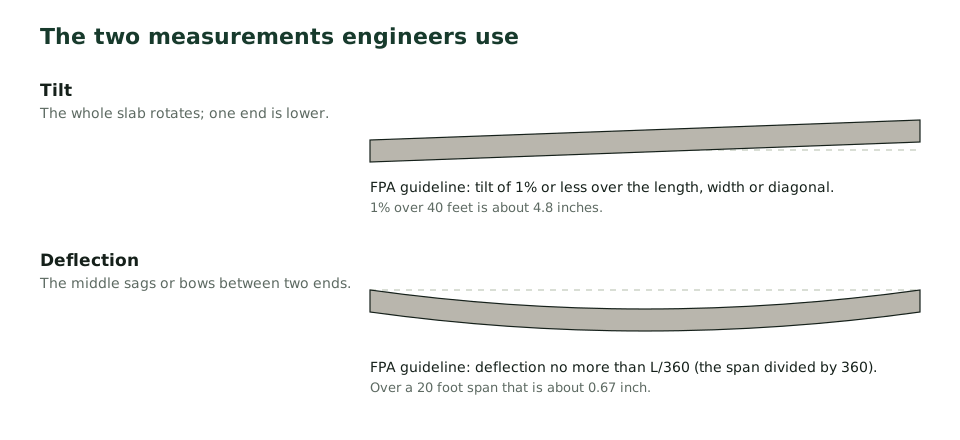
The engineer measures floor heights all over the house. Those readings give two numbers: tilt, where the whole slab leans, and deflection, where part of it sags or bows. The Foundation Performance Association, a Houston professional group, recommends tilt of 1% or less. It recommends deflection of no more than L/360, where L is the length being measured.
Tilt and deflection, the two measurements engineers use. The Foundation Performance Association recommends tilt of 1% or less and deflection of no more than L/360.
The ASCE guidelines add that “A tilt greater than 1 percent is usually noticeable.” On a 40-foot house, 1% of tilt is 4.8 inches from end to end. Over a 20-foot span, L/360 is about two-thirds of an inch.
The association says its limits may not apply if the readings are not taken and worked out its way, so ask how they were taken. These are guidelines, not law. In Texas, only a person with a current license may use “P.E.” or “professional engineer” after their name, so look for it on the report.
Your own engineer, or the company’s?
Either can be licensed, but they answer to different people. Some repair estimates include an engineer’s visit as a line item. You can also hire an engineer yourself, who is paid for the opinion and not for the repair. When bids disagree, that is the opinion to get.
One West Houston homeowner had assessments from four or five repair companies that “all differ quite a bit.” So they asked around for “an unbiased structural engineer.” If you hire your own, ask for the floor readings, a written opinion on the cause, and a repair plan that any company can price.
After a repair, ask the engineer who designed it for a final letter. One source prices it at $200 to $500. Our guide on choosing an engineer or a foundation company covers what the report should contain.
Who to call first
It depends on the question you need answered. If you want a price for repair work, a company inspection is usually free. If you are buying a house, start with a home inspector. If you need the cause from someone with no stake in the repair, hire your own structural engineer.
Your situation
Start with
Then
Buying a house
A TREC home inspector before you close
An engineer if the report lists foundation signs
New cracks, sticking doors or sloping floors
A structural engineer, or a company inspection if you want a bid first
Compare any bid with the engineer’s plan
Bids that disagree
An independent structural engineer
Ask each company to price the engineer’s plan
A repair just finished
The engineer who designed it
A final letter for your records
Selling a house with past repairs
Your repair records and letters
The seller’s disclosure form asks about “Previous Structural or Roof Repair”
Texas does not license foundation repair companies. Bills to create a license passed the Senate in 2011 and died in the House, and a second attempt in 2013 also failed (SB 1399, HB 613). So the checks that matter are yours to make. Each takes a few minutes.
Ask who the engineer is. The Texas engineering board says working out why a foundation moved, or recommending how to repair it, is the practice of engineering (Advisory Opinion 43). Get the engineer's name and look up the license on the state roster.
Check the plumber's license. If the job includes a plumbing test or a leak repair, the plumbing has to be done under a licensed plumber. Look the license up with the Texas State Board of Plumbing Examiners.
Read the warranty before you sign. Get it in writing, see whether it transfers when you sell, and find the clauses that void it. Watering and plumbing conditions are the ones homeowners most often learn about too late.
Ask who pulls the permit. Most cities here charge a permit fee for repairs, and Canton names foundation repair in its fee schedule. Unincorporated county land has no building permit at all. Our permit guide lists each office.
Keep the paperwork. If a job goes wrong, Texas law makes you give the company written notice at least 60 days before you sue under the Deceptive Trade Practices Act (Bus. & Com. Code §17.505). Estimates, contracts, photos and emails are your record.
We pass it to one independent foundation repair company that works in your area. Not a list, and not an auction.
2
They call to set up a visit
Most Tyler-area foundation companies advertise a free inspection or estimate. Ask on that first call, so there are no surprises.
3
You get a written estimate
It should name the repair method, how many piers and where, who designs the repair, the permit, the warranty and the price. Compare it with our published price ranges.
4
You decide
There is no obligation. If you want a second opinion, an independent structural engineer's evaluation usually costs $300 to $800.
Foundation inspection questions
Should I call a home inspector, structural engineer, or a foundation repair company to come check it out to see if I need foundation repair?
It depends on what you need to know. A repair company’s inspection is usually free and gives you a bid. A home inspector reports visible signs but does not have to find the cause. A structural engineer, usually $300 to $800, measures the house and gives an opinion on the cause and the repair. Our guide to choosing an engineer or a foundation company walks through it.
If the home inspector does not see any foundation issues though there should be no need to hire a foundation inspector is that right?
Not always. A Texas home inspection is visual. The inspector does not have to give an exhaustive list of warning signs or enter a crawl space with less than 18 inches of headroom. A clean report means the inspector saw no signs from where they looked. If the house is older, has had repairs, or shows cracks the report missed, an engineer’s evaluation is the next step.
Will the home inspector get under the foundation and ask for an engineer's report?
Not necessarily, on either count. The state’s standards do not require the inspector to enter a crawl space with less than 18 inches of headroom or an opening smaller than 24 by 18 inches, though the report must say where the crawl space was viewed from. They also do not require the inspector to recommend engineering services. If you want an engineer’s opinion, you can hire one yourself.
Would a regular structural engineer not associated with either firm be the way to go for another opinion?
Yes. An engineer you hire yourself is paid for the opinion, not for the repair. Industry estimates put an evaluation and written report at $300 to $800. Ask for the elevation readings and a repair recommendation any company can price, and check the license on the state’s PE roster before the visit.
How much was the engineer's inspection?
Industry estimates put a structural engineer’s evaluation and written report at $300 to $800, and complex or disputed cases can cost more. We could not verify a published fee from a Tyler engineer. One source prices the engineer’s letter after a repair at $200 to $500. Ask for the fee in writing before the visit, along with what the report will include.
Is there a way we can check whether it is level from one side to the other?
Not precisely enough to judge a foundation. Engineers take floor elevations across the whole house, with equipment the Foundation Performance Association says should read to a precision of no greater than 1/8 inch. From those readings they work out tilt and deflection and compare them with guideline limits, such as tilt of 1% or less. A household level on one spot cannot do that.
Sources
Each source was opened and checked on the date shown. If a link has moved, tell us and we will fix it.
Get a written estimate from a local foundation company
Tell us what you are seeing and where the house is. Your request goes to one independent foundation repair company that works in your part of East Texas. Ask them the questions on this page before anyone lifts a shovel.