Tyler is the largest city this site covers: 105,995 people in the 2020 Census and an estimated 113,723 in July 2025. Below are the city records that matter for a foundation job.
How old are Tyler’s houses, and where are the oldest?
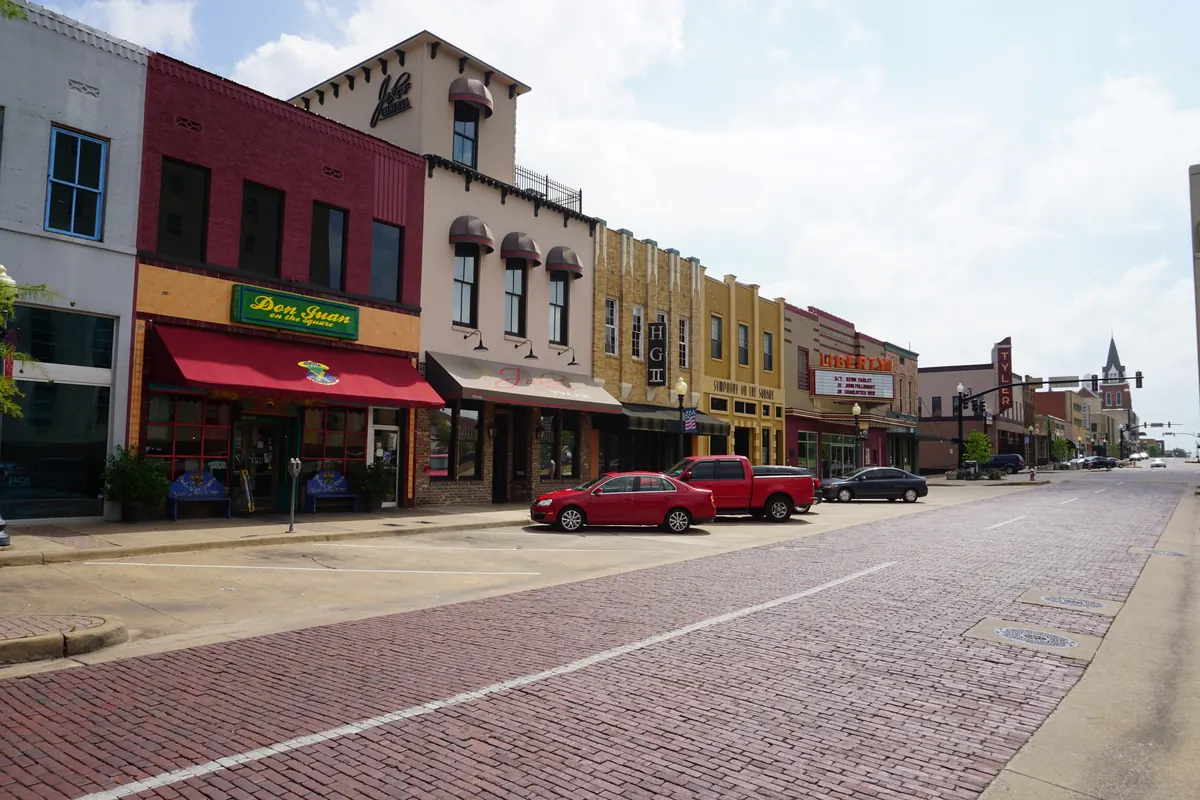
More than half of them predate 1980. Census estimates for 2020 to 2024 count 46,019 housing units in Tyler, and 52.6% were built before 1980, with a median year built of 1978. The city’s comprehensive plan says most of the older housing is downtown, around the Azalea Historic District, in Midtown and in north Tyler.
The Tyler Tomorrow plan puts it this way: “About 52% of the occupied housing units in the City are roughly more than 50 years old, built in 1979 or earlier.” Newer building has gone to what the plan calls “more newly developed areas between Loop 323 and Grande Boulevard.” About 26.4% of the city’s housing dates from 2000 or later.
An older house may already have had foundation work, so ask for any earlier engineer’s report, permit and warranty before you collect bids. If the house stands on piers and beams instead of a slab, the job is different; see house leveling.
Do you need a city permit to repair a foundation in Tyler?
Tyler publishes no rule written for foundation repair, but its rules point to a permit. The fee schedule charges $0.35 per square foot for “All Additions, Alterations, Repairs,” plus a plan check fee of 20% of the permit fee. The city’s FAQ says a permit is needed even to replace sheetrock. Have the company pull it.
The FAQ answer in full: “Yes, a permit is required even if you are only replacing sheetrock and not altering any walls or the structure.” If the company cannot tell you which permit it will pull, call Building Services at (903) 531-1151 before work starts.
Applications and inspection requests go through the city’s eTRAKiT portal, and a permit is good for six months. A plumber on the job needs a separate trade permit, which the city links to the main one.
Not sure the house is inside the city? Tyler’s FAQ points to SmithCountyMapSite.org to check an address. Outside city limits, Smith County has no building permits; our Flint and Gresham page explains what applies there.
What changes inside a Tyler historic district?
It depends on the kind of district. National Register districts such as Azalea and Brick Streets do not require city approval by themselves. Exterior work on one of Tyler’s 138 local landmarks, or inside its two Heritage Neighborhood overlays, needs a Certificate of Appropriateness before the building permit. Call Planning at (903) 531-1175 first.
The rule is city code Sec. 10-792. It covers work on any “exterior architectural feature” of a covered building, which includes “the kind, color and basic texture of all exterior building materials.”
Historic Tyler, Inc., a nonprofit, maps the overlays. Heritage Neighborhood No. 1 has 18 properties bounded by Broadway Avenue, Lindsey Lane, College Avenue and Rusk Avenue. No. 2 has 49 properties roughly bounded by Donnybrook Avenue, Wells Street, Oakland Avenue and the half block north of Charnwood Street.
No city page says whether foundation work counts as an exterior change, such as rebuilding cracked brick or replacing crawl space skirting. The city’s application page also words the rule more broadly than the code does. Ask Planning before you sign, so the certificate and the permit go in the right order.
What is the ground like under Tyler?
Mostly sand or loam over a clay subsoil, according to the 1993 Soil Survey of Smith County. That is a county-level finding, not a test of your lot. The survey still lists moderate shrink-swell as a building-site limit for several common soils. So the ground can move here, though the risk is lower and patchier than on Blackland Prairie clay.
The survey calls the county’s main geologic feature “the Tyler Basin, which is a troughlike depression trending north-northeast and centered near Tyler.” Cuthbert, the most widespread soil series at about 17% of the county, is one the survey flags for shrink-swell on building sites. The cracking Vertisol clays cover only about 2.5%, all on the Sabine River floodplain.
Weather sets the rhythm. At Tyler Pounds Field, NOAA’s 1991 to 2020 normals show 42.1 inches of rain a year. July is the driest month, at 2.1 inches, and August has the hottest normal high, 94.9°F. Our soils guide covers droughts and all four counties.
Who do you call about a leak under the slab in Tyler?
Two calls: a licensed plumber for the leak, and Tyler Water Utilities about the bill. Customer service is (903) 531-1230, and the after-hours emergency line is (903) 597-6541. Once the leak is fixed, you can ask the utility for a leakage credit on water lost to a concealed leak.
The credit comes from city code Sec. 19-33. The utility can adjust “no more than three (3) monthly water bills,” and you still pay “no less than the normal water use plus one-half (½) of the calculated loss.” Attach a legible copy of the repair bill, and fix every leak first. Any approved credit waits until your use is back to normal, which in most cases means the next billing cycle after the repair.
A credit is not automatic. The form covers concealed or hidden leaks without naming slab leaks, and it needs “specific details of the leak and the repair that was done.” More on the repair itself: slab leak repair.
What rules come with a Lake Tyler lot?
Lease rules set by the City of Tyler. Lake Tyler and Lake Tyler East are the city’s water-supply lakes. The city says “all transfers of leases, including transfers to heirs, must be approved by the City of Tyler.” Construction permits at the lakes go through Building Services at (903) 531-1151.
Lease questions go to (903) 531-1238. The city also notes that it “does not own the residential lots surrounding Lake Tyler East.” Before foundation work on a lake house, confirm who holds the lot and which permit the job needs.
What will foundation repair cost in Tyler?
No Tyler foundation company we checked publishes its prices, and no public dataset of local costs exists. Industry estimates put a slab repair with piers at $5,000 to $25,000, and a pier-and-beam re-shim or re-level at $1,200 to $4,000. Inside the city, the permit fee comes on top of the repair price.
| Job | Typical total | Where the figure comes from |
|---|---|---|
| Slab repair with piers (a corner to the whole perimeter) | $5,000 to $25,000 | Contractor averages: Stratum about $5,300 (DFW), Anchor about $11,000 for pressed piles, Olshan $11,950 (national, 2026); HomeGuide and Angi put underpinning at $10,000 to $30,000 |
| Pier and beam re-shim or re-level | $1,200 to $4,000 | Angi (2026), Anchor (2026) |
| Pier and beam repair with new piers, beams or sills | $5,000 to $15,000 | Anchor, Thomas Engineering (2025), HomeGuide |
| New or added piers under a pier and beam house | $800 to $4,000 each | Angi, HomeGuide (pier reinforcement $1,500 to $3,000 per pier) |
| Beam replacement | $400 to $4,000 per beam (sources disagree widely) | Angi $400 to $1,200; HomeGuide $1,500 to $4,000 |
| Sill plate replacement | $100 to $200 per linear foot | Angi (2026), HomeGuide (2025) |
| Crack injection (seals a crack, does not stop movement) | $250 to $800 per crack | HomeGuide, Angi, HomeAdvisor |
| Mudjacking (slab lifting with grout) | $3 to $9 per square foot | Angi (2,631 projects, 2026), HomeGuide |
| Polyurethane foam lifting | $5 to $25 per square foot | Angi (2026), HomeGuide |