Before anyone can price a foundation repair, they need to know what the house sits on. Around Tyler, that is usually a concrete slab poured on the ground or a pier and beam frame raised over a crawl space. The two are repaired in different ways, and the prices differ too.
How can I tell if my house is on a slab or pier and beam?
Start outside. Vents, skirting or a small access door along the bottom of the walls, and steps up to the front door, point to pier and beam. Walls that sit low on a concrete edge, close to the ground, point to a slab. Then check your Texas home inspection report, which names the foundation type.
Inside, a wood floor that sounds hollow or gives a little underfoot hints at a raised frame. A floor that feels solid, like a garage floor, hints at a slab. Treat these as clues, not proof.
The surest answer is on paper. Under the state’s Standards of Practice, a Texas home inspector must report “the type of foundations” and “the vantage point from which the crawl space was inspected.” If you bought the house with an inspection, the report says which you have.
| Slab | Pier and beam | |
|---|---|---|
| What holds the house up | Concrete poured on the ground, with thicker beams along the edges | Wood floor framing on beams, resting on short piers over a crawl space |
| Clues outside | Walls sit low on a concrete edge | Vents, skirting or an access door; steps up to the front door |
| What an inspector reports | Signs of movement (doors, cracks, sloping floors, brick) and exposed or damaged reinforcement | The same signs, plus beams, joists, piers, posts, sills, subfloor, and crawl space air flow and drainage |
| Common repairs | Piers under the slab; lifting where floors slope too much | Re-shimming, new piers, beam or sill work |
| Typical cost (industry estimate) | $5,000 to $25,000 for a pier job | $1,200 to $4,000 to re-shim; $5,000 to $15,000 with new piers, beams or sills |
What is the difference between a slab and pier and beam?
A slab is a layer of concrete poured on the ground, with thicker beams along its edges. A pier and beam house stands on short piers, with beams across them and a wood floor frame on top. That leaves a crawl space under the floor. Both rest on the same soil, and both can move with it.
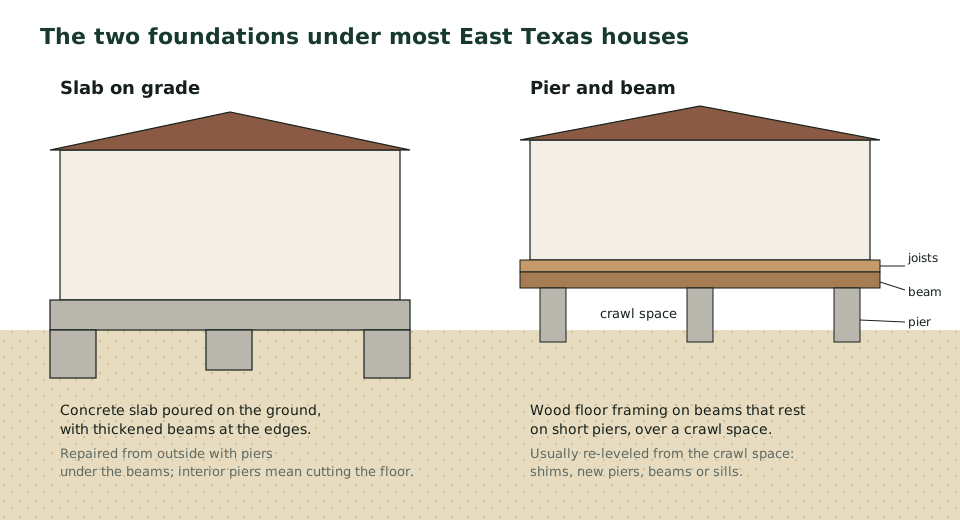
The difference decides where the repair happens. On a slab, the work is under the concrete: piers set below the edge beams, and sometimes inside the house. On pier and beam, the work is under the floor, in the crawl space.
That is why access matters on a raised house. One North Texas engineering firm says pier and beam prices depend on how easy the crawl space is to reach and how much wood has to be replaced.
Does East Texas soil move a slab and a raised house the same way?
The soil does not care what sits on it. Where the ground holds clay, it shrinks when dry and swells when wet, and the Smith County soil survey says that movement can damage building foundations. Either type of house can move with it. What differs is where you see the damage.
How much clay sits under your lot depends on where you live. Most of Smith County’s uplands are sandy or loamy soils over clay-enriched subsoils, not Blackland Prairie clays like Houston Black.
Even so, the 1993 county soil survey names shrink-swell as a limit on building sites for several soils. They include Cuthbert, the most widespread soil in the county, plus Bowie, Sacul and Kullit. For Bowie it calls the potential “moderate.”
The other counties differ. About 63% of Van Zandt County lies in soil units whose limits include shrink-swell, mostly rated “high.” Henderson County splits: sandy soils in the east, and shrink-swell soils across about 32% of the county in the west-central part. Cherokee County’s most recent published soil survey dates from 1959, so treat soil claims there as provisional.
Tyler also has wet months and dry ones. June, the wettest month, averages 4.38 inches of rain, and July, the driest, 2.10 inches (NOAA 1991 to 2020 normals). Our guide to East Texas soils and foundations has the county detail.
How the damage shows up
Texas home inspectors look for the same warning signs on both types. The state’s list includes:
- doors that bind, are out of square or will not latch
- gaps in framing or trim boards
- sloping floors
- cracks in walls, ceilings, floors or windows
- brick or stone that cracks, bows or rotates
Our guide to signs of foundation problems explains each one.
The same rules have inspectors report problems with parts such as “beams, joists, bridging, blocking, piers, posts, pilings, columns, sills or subfloor.” They also cover crawl space ventilation and drainage “that is not performing.” Most of those parts live under a pier and beam floor.
Wood under a raised floor can rot, too. The Texas seller’s disclosure form asks sellers about “Termite or Wood Rot Damage Needing Repair.”
On a slab, engineers describe movement as tilt, where the whole slab leans, and deflection, where it bows or sags between two points. The Foundation Performance Association recommends tilt of 1% or less and deflection of no more than L/360, about 0.67 inch over 20 feet. These are guidelines, not law.
How is a slab foundation repaired?
For a slab, the repair Texas contractors price is piers. These are supports set under the concrete, mostly along the edges, and the slab can be lifted onto them where floors slope too much. The four common types are pressed concrete, drilled concrete, steel push and helical. A pier job runs $5,000 to $25,000 (industry estimate).
Lifting has limits. The ASCE Texas Section repair guidelines say, “It is unlikely that elevation adjustments will result in a level foundation.” So do not expect a repaired slab to be perfectly flat.
You may also see two other slab methods. Mudjacking lifts a slab with grout and runs $3 to $9 per square foot. Polyurethane foam lifting runs $5 to $25 per square foot. Texas contractor sources describe using both mainly to fill gaps under the slab after a pier lift.
Crack injection, at $250 to $800 per crack, seals a crack but does not stop movement. Our guide to foundation repair methods compared covers how each pier goes in and why bids differ. The slab foundation repair page walks through a job.
How is a pier and beam house repaired?
The work happens under the floor, in the crawl space. The company can re-shim to bring sagging floors back up, add or replace piers, or replace damaged beams and sills. Re-shimming or re-leveling runs $1,200 to $4,000, and work with new piers, beams or sills runs $5,000 to $15,000 (industry estimates).
Sills are priced by length, at $100 to $200 per linear foot. The crawl space itself matters too. State inspection rules count crawl space ventilation or drainage that is not working as deficient. So ask the company what caused the sag, not only how to lift it.
Leveling may not be a one-time job. Anchor Foundation Repair, a Texas contractor, lists a maintenance visit for returning pier and beam customers on its cost page. Ask what the warranty covers after the first leveling, and for how long.
A home inspector may not see it all. Under the state’s rules, an inspector does not have to enter a crawl space if the headroom is under 18 inches. The same goes if the opening is smaller than 24 inches wide by 18 inches high. Our house leveling page covers the work in more detail.
What does each type cost to repair?
Industry estimates put a slab pier job at $5,000 to $25,000. A pier and beam re-level runs $1,200 to $4,000, or $5,000 to $15,000 when piers, beams or sills are replaced. These are not Tyler prices. No Tyler company publishes its prices, and no government or university cost dataset exists for this area.
| Job | Typical total | Where the figure comes from |
|---|---|---|
| Slab repair with piers (a corner to the whole perimeter) | $5,000 to $25,000 | Contractor averages: Stratum about $5,300 (DFW), Anchor about $11,000 for pressed piles, Olshan $11,950 (national, 2026); HomeGuide and Angi put underpinning at $10,000 to $30,000 |
| Pier and beam re-shim or re-level | $1,200 to $4,000 | Angi (2026), Anchor (2026) |
| Pier and beam repair with new piers, beams or sills | $5,000 to $15,000 | Anchor, Thomas Engineering (2025), HomeGuide |
| New or added piers under a pier and beam house | $800 to $4,000 each | Angi, HomeGuide (pier reinforcement $1,500 to $3,000 per pier) |
| Beam replacement | $400 to $4,000 per beam (sources disagree widely) | Angi $400 to $1,200; HomeGuide $1,500 to $4,000 |
| Sill plate replacement | $100 to $200 per linear foot | Angi (2026), HomeGuide (2025) |
| Crack injection (seals a crack, does not stop movement) | $250 to $800 per crack | HomeGuide, Angi, HomeAdvisor |
| Mudjacking (slab lifting with grout) | $3 to $9 per square foot | Angi (2,631 projects, 2026), HomeGuide |
| Polyurethane foam lifting | $5 to $25 per square foot | Angi (2026), HomeGuide |